Delivery

To your Kindle by email, early each morning wherever you are.

The Quiet Courier

“Read It to the Last Page”

Price

Four dollars a month after fourteen free days.

A morning paper for your e-reader, with a last page

About twenty minutes of news, science and history, set in columns like a 1920s broadsheet and emailed to your Kindle before you wake up.

Most news now arrives as an endless scroll, built to keep you reading. The Quiet Courier comes once a day, as a file on your reader, and it ends. You read it front to back, do the puzzles, and you are finished with the news until tomorrow.

Every edition is put together from writing that is free to republish: research explained by the people who did it, reporting from around the world, science from the labs and the great telescopes, the week’s economy, a forecast for your city, this day in history, a newspaper printed on this date a hundred years ago, and the next chapter of a classic novel. Each piece runs whole, with its author and license printed beside it.

The page is cut to the size of your screen, so a Kindle Paperwhite shows a two-column page and a Kindle Scribe shows three, with no zooming or panning. Black ink on white, because that is what e-ink does well.
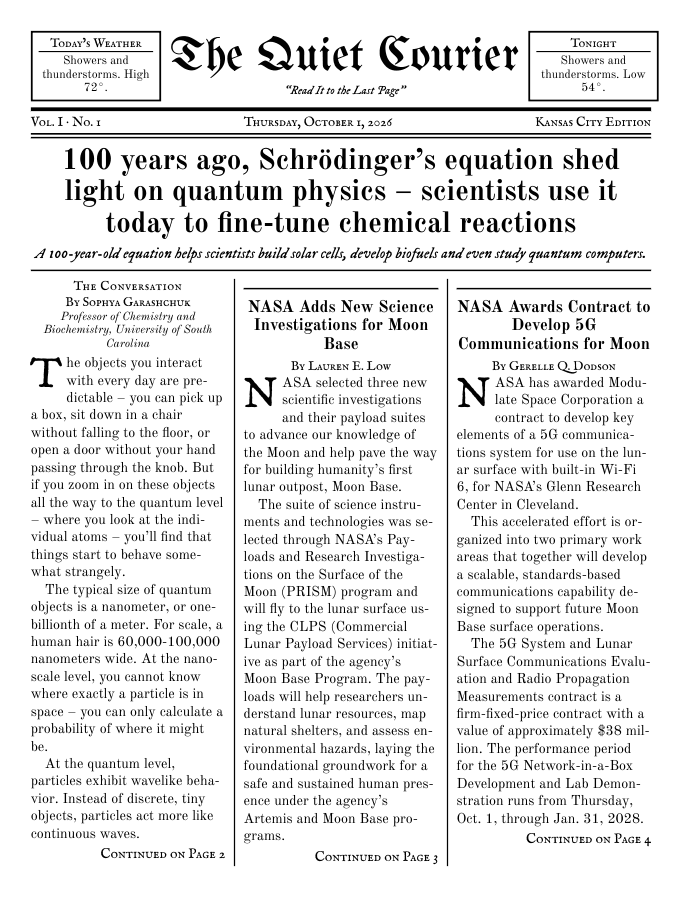
The front page of a sample edition. The lead story is about Schrödinger's equation at 100, with two NASA stories beside it and the weather in the masthead.
The Kansas City edition for October 1, 2026, as it appears on a Kindle Scribe.

What’s inside

The lead story

One long piece on page one, jumped inside like a real paper. Usually research explained by the scientist who did it.

The Conversation

The World in Brief

The day’s main events, a sentence each, so you know what happened without reading about it all morning.

Wikipedia’s Current events portal

World

Two reports from places you probably weren't reading about, written by people who live there.

Global Voices

The States

A few times a week, a reported story on how a state government is changing schools, health care, housing or elections.

CalMatters

Ideas

One longer read beyond science: politics, the economy, health, history or culture, explained by someone who studies it.

The Conversation

Science and space

Shorter pieces from the missions, satellites and labs, including discoveries from the great telescopes, with a halftone picture when there is one.

NASA, NASA Earth Observatory and the European Southern Observatory

The economy in brief

Jobs, unemployment, prices and pay, the latest official figures laid out in a small table. Updated as new figures are released.

U.S. Bureau of Labor Statistics

Your weather, if you want it

Today and tonight for any city in the world in the corners of the masthead, plus the full forecast inside. Or leave it out.

National Weather Service and MET Norway

This day in history

A few of the day's anniversaries through the years, the gentler ones: inventions, openings, discoveries, first performances.

Wikipedia

A hundred years ago today

Stories from a newspaper printed on this date in 1926, taken from the scanned original.

Library of Congress

A novel, a chapter a day

A classic in daily instalments of about five minutes, the way novels used to run in newspapers. The Hound of the Baskervilles first, then The Time Machine.

Public domain fiction

Puzzles

A sudoku that gets harder through the week, from a gentle Monday to a tough Saturday, and a cryptogram made from a line of verse.

Made fresh for each edition

The last page

A poem, a word search built from its words, and the almanac: sunrise, sunset, and the moon.

Public domain verse

Pages from the sample editions

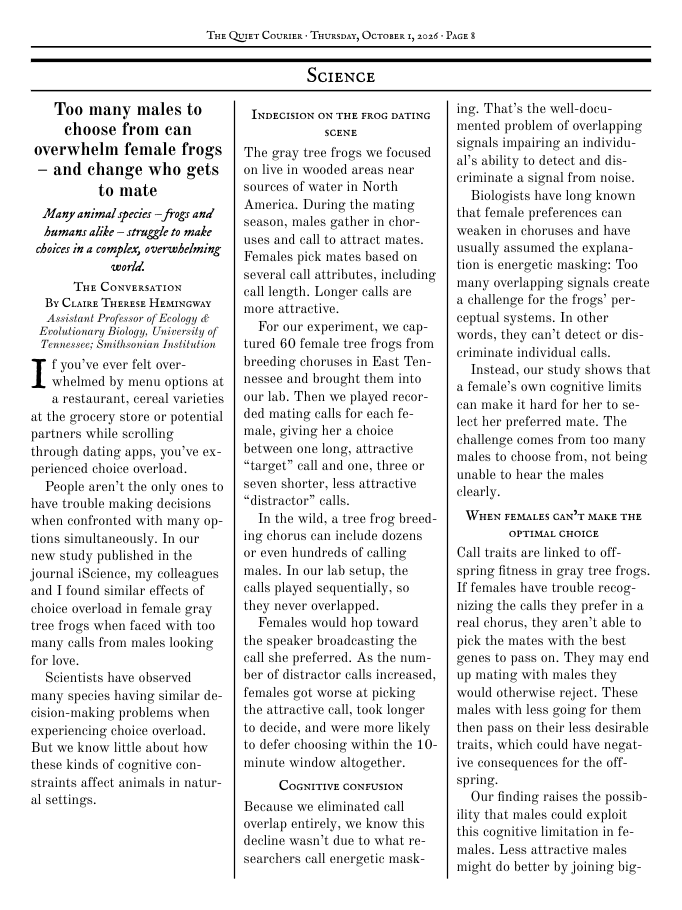
A science page carrying a study of how female tree frogs choose between calling males, by researchers at the University of Tennessee.
Science. Long stories run across columns and jump between pages, as in a printed paper.
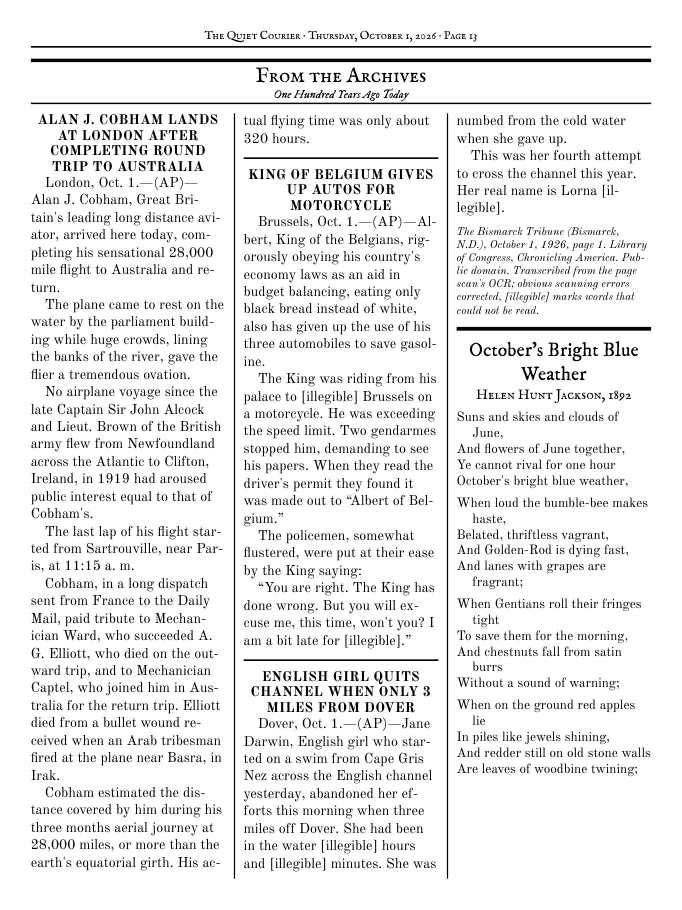
A page of stories reprinted from The Bismarck Tribune of October 1, 1926.
From the archives: The Bismarck Tribune, October 1, 1926.
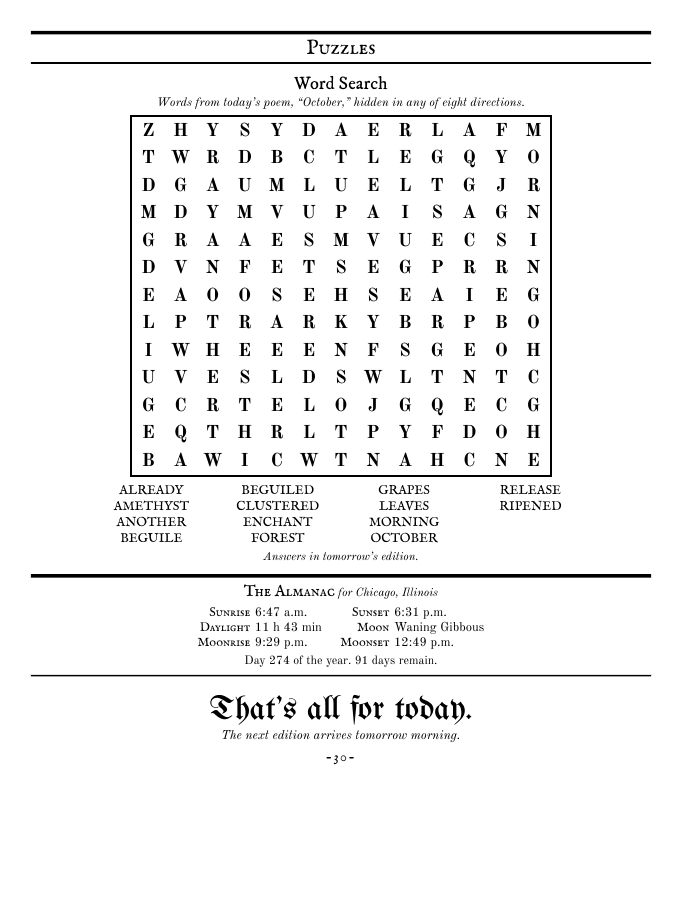
The last page: a word search, the almanac for Chicago, and the words That's all for today.
The last page. The word search uses words from the day’s poem.

How it reaches your reader

  1. Sign in with your email

    No password. We send a link that signs you in.

  2. Choose your reader and weather

    The reader sets the page size. A city adds its forecast and almanac; the news stays the same.

  3. Approve our address with Amazon

    Kindles only accept files from senders you list. The setup guide shows where.

  4. Read it with your coffee

    The paper appears in your Kindle library each morning. Send yourself a test copy first to check.

Subscription

$4 a month

The first 14 days are free. It renews monthly until you cancel, which you can do from your account page at any time.

No card needed to start. The free days begin with your first paper, and nothing is charged unless you subscribe.

Questions

Which readers does it work with?

Any Kindle, through Amazon’s Send to Kindle email address. PocketBook readers have their own email address and work the same way, and Boox tablets can receive it through the Kindle app. Kobo, reMarkable and other readers get a private download link instead, which also works as a catalog in KOReader.

Is any of it written or summarized by AI?

No. Every article is written by a person and printed whole, under its author’s name, with the license it was published under. Nothing is rewritten or condensed.

Why does the paper end?

Because a feed doesn’t. Each edition is fitted to about twenty minutes of reading. When you reach the puzzles, you’ve read the news for the day.

Does my city change the news?

No. The news is the same in every edition. Your city only sets the weather forecast, sunrise and sunset, and the almanac. Any city or town in the world works, or you can leave local weather out.

Can I stop it for a while?

Yes. Pause delivery from your account page and resume it when you’re back. Cancelling is on the same page as everything else.

What do you keep about me?

Your email, the name printed on your paper, your city or time zone, your reader size and the address your paper goes to. No tracking scripts. The privacy policy has the details.